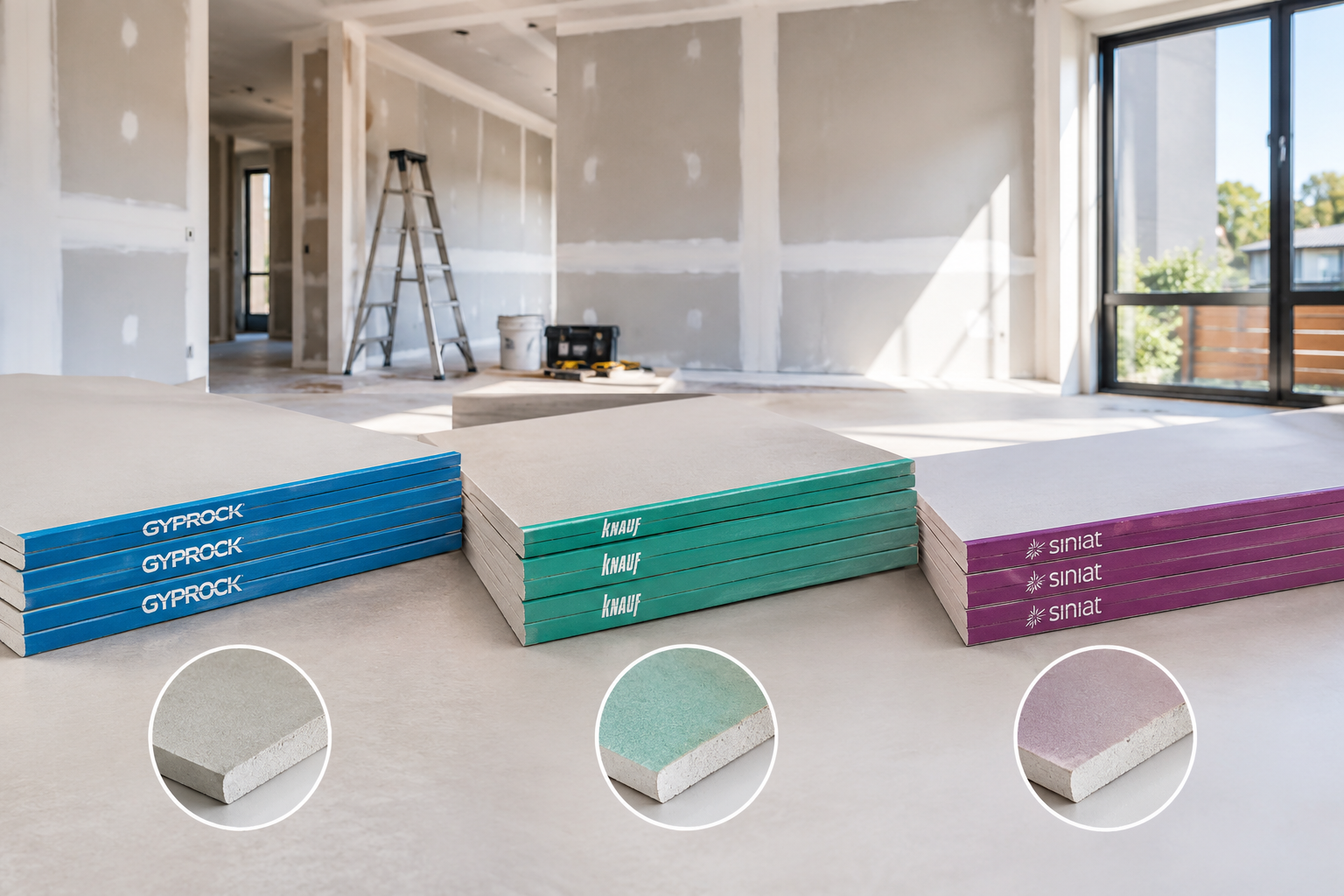
Plasterboard is the flat gypsum sheet that forms most interior walls and ceilings in Australian homes. Gyprock, Knauf and Siniat are the three brands you will hear most often from builders, plasterers and hardware staff in Melbourne.
If you are renovating a Brunswick terrace, building in Tarneit or Point Cook, or fixing up a ceiling in Hawthorn, you have probably asked the same thing: does the brand actually matter? Quotes sometimes name one brand and sometimes none at all, and it is hard to know whether you are getting a good deal or a compromise.
Here is the honest answer from a team that installs all three. Each brand makes good plasterboard, and in most homes the right board type for the room matters more than the logo on the back. Below, we explain how the brands differ, which board suits which room, and what Melbourne conditions mean for your choice.
What Is Plasterboard, and Why Does the Brand Question Come Up?
Plasterboard is a sheet of gypsum core wrapped in heavy paper, fixed to timber or steel framing, then taped and set to create a smooth wall or ceiling. It is also called gyprock, drywall, gypsum board or wallboard.
“Gyprock” is both a brand and a nickname. Many Australians say “gyprock” the way they say “esky” or “bubbler”, even when the sheet is not made by that company. That is why quotes can be confusing.
Plasterboard only became common in Australian homes from the 1960s, according to Siniat’s own industry history, and it now lines the majority of new houses and apartments.
Meet the Three Brands
Gyprock
Gyprock is made by CSR, which is part of Saint-Gobain. It is the best known name in the country, and its range includes specialty boards sold for fire, moisture and sound control, such as Fyrchek, Aquachek and Soundchek. Many Melbourne builders default to Gyprock simply because merchants stock it everywhere.
Knauf
Knauf is a German family owned group with a long history in gypsum products. In Australia, Knauf is one of the three major manufacturers and supplies standard and performance boards through trade distributors. Product names and ranges have changed as the business has restructured in recent years, so always ask your plasterer which Knauf board is being quoted.
Siniat
Siniat is the brand of the Etex Group. It arrived in Australia in 2021, when Etex took over the business that was previously known as Knauf Plasterboard, and before that Lafarge. The local range did not change with the rebrand. Siniat makes plasterboard at its Altona plant here in Victoria, along with plants in New South Wales and Queensland, which is handy for Melbourne supply.
Competition authorities and industry reports describe these three as the top players in the Australian plasterboard market, so you are choosing between the big names whichever way you go.
How Do They Compare? The Short Answer
Gyprock, Knauf and Siniat all manufacture plasterboard to the Australian Standard AS/NZS 2588, and all offer standard, fire rated, moisture resistant and acoustic boards. For a typical Melbourne home, there is no meaningful difference in everyday performance between a correctly installed sheet from any of the three.
What does differ is availability, the exact product ranges, installation details and, sometimes, price per sheet at your local supplier.
Strength and Durability
Standard boards come in 10mm and 13mm thicknesses. Most homes use 10mm on walls and 13mm on ceilings or where extra strength is wanted, although your plasterer and builder will confirm this against the plans.
All three brands make both thicknesses. Where you will notice a difference is in specialty impact resistant boards, which add a tougher core or lining for hallways, kids’ rooms and garages. If you have teenagers, a dog with big paws or a lot of foot traffic, ask about these.
Fire Resistance
Plasterboard is naturally fire resistant because the gypsum core holds water that slows heat transfer. Fire rated boards, such as Gyprock Fyrchek and the equivalent ranges from Knauf and Siniat, add glass fibres and a denser core.
You will need fire rated board in places like:
- Walls between townhouses
- Garage walls that adjoin living areas
- Ceilings under some upstairs rooms
- Walls close to boundaries
The Australian Building Codes Board publishes the National Construction Code, which sets these requirements, and your building surveyor will specify the rating.
Moisture Resistance for Bathrooms and Laundries
Melbourne is not as humid as Brisbane, but steamy bathrooms, poorly ventilated laundries and old terraces with rising damp still cause trouble. Moisture resistant board has a treated core and paper, and it is the right choice for walls outside the shower recess, behind vanities and in laundries.
Important point: moisture resistant plasterboard is not waterproof. Wet areas still need a proper waterproofing membrane applied by a licensed tradesperson. Skipping this step is one of the most common causes of mould and costly repairs we see across Melbourne.
Sound Control
If you live near a tram line in Northcote, a busy road in Footscray or share a wall in an apartment, acoustic board can make a real difference. These denser sheets, such as Gyprock Soundchek and the matching products from Siniat and Knauf, reduce noise travelling between rooms.
The board is only part of the answer. Insulation in the cavity, staggered joints and sealed gaps do just as much. Our guide on external wall cladding in Melbourne explains how the outer and inner layers of a wall work together:
Finish Quality and Cracking
A smooth finish comes from good plastering rather than the board alone. Melbourne’s reactive clay soils move with the seasons, particularly across the west and north, and that movement can open hairline cracks at joints and door frames. Control joints, correct fixing and quality jointing compound reduce the risk.
AS/NZS 2589 covers the application and finishing of gypsum linings, and the Victorian Building Authority is the body to contact if you are unsure whether work has been done properly.
6. Sustainability and Local Supply
Plasterboard is recyclable, and manufacturers use recycled paper in the liner. Siniat has publicly highlighted its local manufacturing and carbon neutral options, and each brand has sustainability targets of its own. If lower embodied carbon matters to you, ask us which product ranges carry independent certifications.
Local manufacturing also helps with supply. Boards made in Victoria are less likely to be caught in freight delays that hit imported products.
7. Price and Availability
Price per sheet varies between merchants and changes often, so we will not quote numbers that will date quickly. In our experience the gap between brands for like for like boards is small compared with the cost of labour, framing, insulation and finishing.
What can cause delays is stock. If you have chosen a specialty board, confirm supply before demolition begins.
Which Brand Is Best for Which Room?
| Room or situation | What to prioritise | Brand note |
| Living room and bedrooms | Standard 10mm, good finish | Any of the three works well |
| Ceilings | 13mm or lightweight ceiling board | Check span and framing spacing |
| Bathrooms and laundries | Moisture resistant board plus waterproofing | Ranges available from all three |
| Between townhouses or near garages | Fire rated board | Specified by the plans and surveyor |
| Home theatre or shared walls | Acoustic board and insulation | Compare ratings for the exact system |
| Hallways and kids’ areas | Impact resistant board | Ask what each brand offers |
So, Which Plasterboard Brand Is Best for Melbourne?
For most Melbourne homes, the best brand is the one that suits the room, is in stock, and is installed by a plasterer who follows the manufacturer’s instructions. We hold certifications with all three, so we have no reason to push one over another. We recommend based on your plans, your budget and the conditions in your property.
As a rule of thumb:
- Choose Gyprock if you want the most widely stocked name and a very broad range.
- Choose Knauf if your builder or supplier recommends a specific Knauf system.
- Choose Siniat if local Victorian manufacturing and carbon neutral options appeal to you.
Why Melbourne Homeowners Trust Vista Plastering
We have been plastering Melbourne homes for [X years], with [X] completed projects across the suburbs. Our plasterers are police checked and fully insured, and we use manufacturer approved fixing and finishing methods so your warranty stays valid. Whether you live in an Edwardian in Hawthorn or a new build in Craigieburn, we match the board, the finish and the schedule to your home.
Frequently Asked Questions
How do I know which plasterboard brand my builder is using?
Check the printed branding on the back of a spare sheet or the paper on the stack. You can also ask your plasterer or builder to list the board brand and type on your quote, so there are no surprises on site.
Is Gyprock better than Knauf or Siniat?
Not in every case. Gyprock is the most recognised name, but Knauf and Siniat both meet the same Australian Standard and offer comparable fire, moisture and acoustic boards. The correct board type for each room matters more than the brand.
What thickness plasterboard should I use for my walls in Melbourne?
Most homes use 10mm board on walls and 13mm on ceilings or areas needing extra strength. Your plasterer will confirm thickness based on framing spacing, the plans and any fire or acoustic requirements.
Can I use moisture resistant plasterboard in a shower?
No. Moisture resistant board is suitable for bathroom walls outside the wet zone, but showers need a licensed waterproofing membrane over the sheet. Plasterboard alone will not stop water from reaching the frame.
How much does it cost to plaster a room in Melbourne?
It depends on room size, ceiling height, board type and finish level. Labour, insulation and preparation usually cost more than the board itself, so the best approach is a written quote after a site visit.
Does plasterboard crack more in Melbourne?
It can, because reactive clay soils move with wet and dry seasons. Correct fixing, control joints and quality jointing compound reduce cracks, and a good plasterer will plan for movement from the start.
Conclusion: Choose the Right Board, Then the Right Plasterer
Gyprock, Knauf and Siniat all produce reliable plasterboard for Melbourne homes. The smarter question is which board type your room needs, how it will be fixed and who will finish it. Take fire, moisture, sound and impact needs into account, confirm stock early and insist on written specifications.
Ready for a plasterer who will recommend the right board without a sales pitch? Call Vista Plastering Melbourne on +61 1300 847 827 or request a free quote at today.